Free tracked US shipping on every order

How to Choose a USB Heated Vest: Zones, Fit, Layers
When the mornings turn sharp in late October, a heated vest is one of the simplest ways to add warmth without piling on bulk. It keeps the warmth on your middle and back, leaves your arms free, and fits under a jacket or over a long-sleeve top. A USB heated vest runs from a power bank you carry in a pocket, so there is nothing to plug into a wall while you are out.
This guide walks through what to look at before you buy one: heating zones, heat settings, layering, sizing, the power bank and washing. Where it helps, we use our own Women's USB Heated Vest as the example, and we only mention what its product page actually says.
How a USB heated vest works
A heated vest is an ordinary vest with thin heating panels sewn into the lining. A cable runs from the panels to a USB plug, and you connect that plug to a power bank. A button on the vest switches the heat on and steps through the settings.
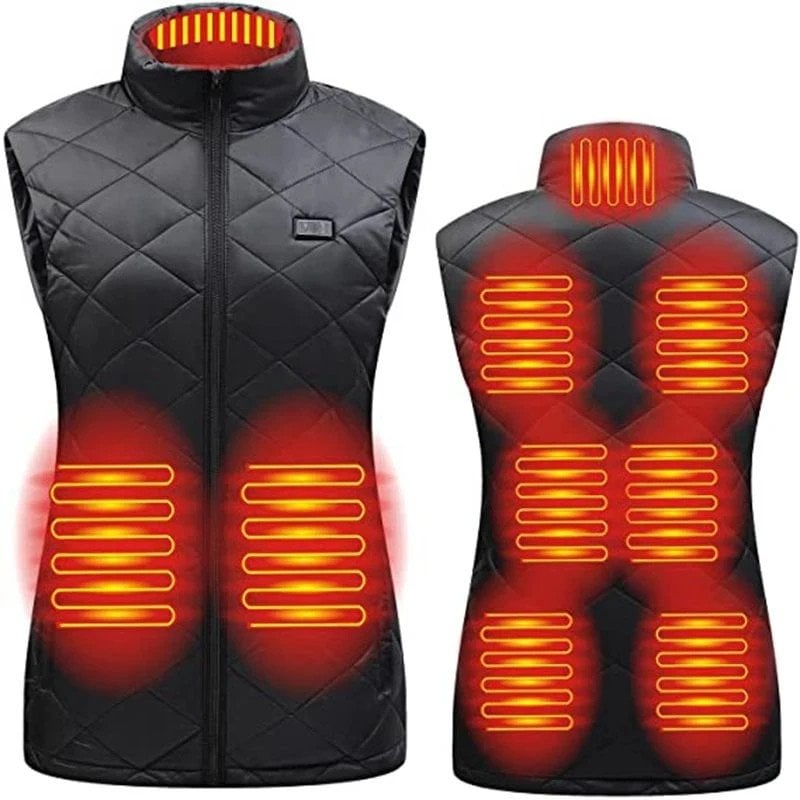
Our vest, for example, has carbon fiber panels across the waist and upper back, and three heat settings on one button. It runs from a 5 V, 2 A USB power bank, which is not included.
Think of it as two parts: the vest decides where the warmth goes, and the power bank decides how long it lasts.
Heating zones: where do you want the warmth?
A "zone" is one heated panel. The zone count tells you how many panels a vest has and, roughly, how much of the vest they cover. It does not tell you how hot the vest gets.
- Fewer zones put the warmth in a few places, usually around the waist and lower back. That suits you if the chill mostly gets to you around your middle.
- More zones spread the warmth over a larger part of the vest, for example across the upper back as well as the waist.
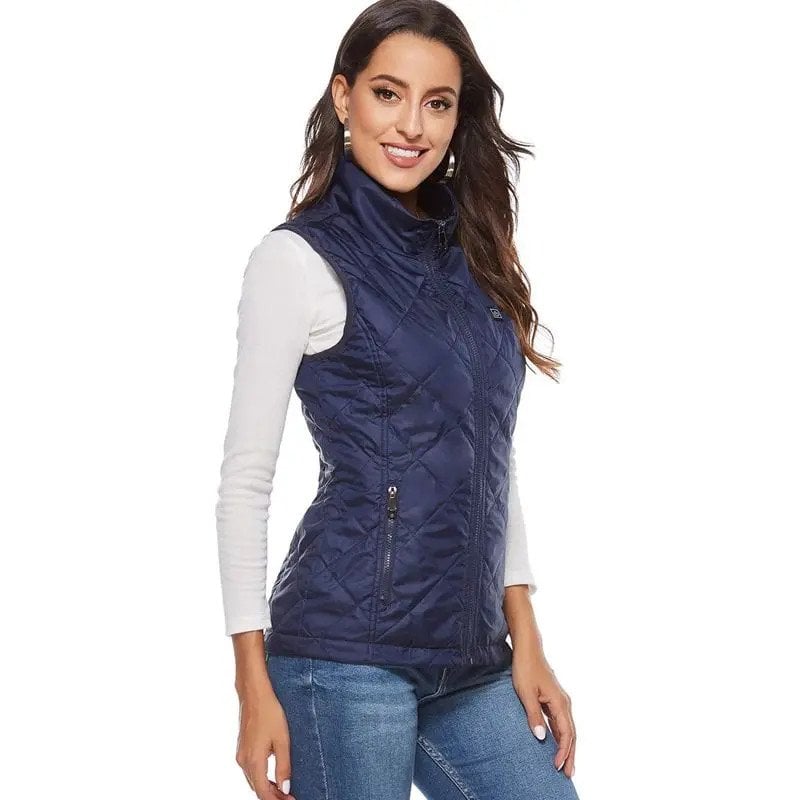
Our vest comes in a 4-zone version and a 9-zone version, each in black or blue. The product photos show where the panels sit in each one, which is the easiest way to compare them. Think about where you notice the cold first when you are outside, and pick the layout that covers it.
Heat settings
Many heated vests have a small number of preset settings rather than a dial, and you step through them with one button. A good habit is to start on the lowest setting and move up only if you need to. A lower setting draws less from the power bank, so it lasts longer, and once you have been moving for a while it is easier to judge how warm you really want to be.
Layering: keep the warmth close
A heated vest warms what is right next to it. How you layer around it decides how much of that warmth you actually feel.
- Underneath: a thin base layer, such as a long-sleeve tee or a thermal top. A thick sweater between you and the panels holds the warmth away from you.
- The vest itself: worn close to the body, so the panels sit against your base layer.
- On top: on cold or windy days, a shell or jacket over the vest stops the wind from carrying the warmth away.
On a mild fall afternoon, the vest on its own over a long-sleeve top may be all you need. As the weather gets colder, add the outer layer before you turn the heat up.
Sizing: close, not tight
Fit matters more with a heated vest than with an ordinary one. If it is loose, the panels hang away from you and much of the warmth goes into the gap. If it is tight, there is no room for the layer you need underneath, and it can feel restrictive when you reach up or sit down.
A simple way to choose:
- Put on the layer you plan to wear under the vest.
- Measure around the fullest part of your chest, over that layer.
- Compare the number with the size chart. For our vest, the chart is among the product photos and lists chest, length, shoulder and hem for each size from S to XXL.
- If you fall between two sizes, think about what goes underneath. A thin base layer suits the smaller size; a thicker mid layer may need the larger one.
Our vest is a women's cut. Length is worth a look too. A vest that is too short can ride up and leave a gap at the waist when you bend, which is exactly where the lower panels sit.
The power bank: the part people forget
A USB heated vest needs a power bank, and many are sold without one. Ours is, so plan for it before the first cold morning. You may already own one that works.
Three things to check on the power bank:
- Output. The label on the power bank lists its output for each port. For our vest you want a USB port that supplies 5 V at 2 A. A port that can supply more current is fine, because the vest only draws what it needs.
- Plug. Look at the plug on the vest's cable and make sure the power bank has a matching port.
- Capacity. A larger capacity generally means more time between charges, and also a heavier bank in your pocket.
Batteries give less in the cold, so keep the power bank in an inside pocket or under a layer rather than in an outer pocket open to the wind. If you plan to be out for a long time, charge it fully the night before.
How long a vest runs depends on the setting, the power bank and the weather, which is why we do not give a single number. If you would like to see the arithmetic behind it, our separate post on choosing a power bank for heated gear walks through a worked example.
Comfort and safety habits
A heated vest is simple to use, and a few habits keep it that way:
- If it ever feels too hot, turn it down or switch it off.
- Wear it over a layer rather than against bare skin.
- Read the manual for any warnings, such as not wearing it while sleeping, and follow them.
- Keep the connector and the power bank dry. If the vest gets soaked, disconnect it and let everything dry before you use it again.
- Check the cable now and then. If it looks damaged, stop using the vest.
Washing: plan for it before you buy
Before any wash, unplug the cable and take the power bank out, then follow the care label exactly. Some heated clothing can go in a machine on a gentle cycle and some is hand wash only, so the label is the final word. Let the vest dry completely, connector included, before you plug it back in.
The same goes for storage at the end of the season: put it away clean and fully dry, folded loosely rather than creased hard across the panels, and keep the power bank somewhere cool and dry on its own.
A quick checklist before you buy
- Where do you want the warmth: mostly around the waist, or across your back too?
- What will you wear under it, and what will go over it on the coldest days?
- Does the size chart match your chest measurement taken over your base layer?
- Do you have a power bank with a 5 V, 2 A USB output, or do you need to get one?
- Is the care label something you can follow at home?
If you are ready to look, our Women's USB Heated Vest, 4 or 9 Zones comes in both zone layouts and in sizes S to XXL. For gloves, insoles and the rest of our warm gear, see the Heated Gear collection.
Share